‘LACMA not LackMA’ ideas competition
Re-imagining and Restructuring Space
Since the mid-60s LACMA has been a vital and vibrant part of the Los Angeles cultural scene. The inhabitants of the city have embraced the museum and the space as their own, and it has become an integral part of the city’s cultural fabric, woven into its memory and history.
Given the current pandemic crisis and the likely adverse economic conditions that will follow, we have chosen to adopt a more sustainable option by adapting and reusing part of the original buildings. In this way we shall preserve the best elements of the past while creating a more contemporary multiuse, alternative space that becomes an iconic landmark for the City of Angels.
The question then arises to what extent the existing buildings of this important landmark heritage needs to be preserved and strengthened according to earthquake code. The new engineering approaches give us viable rational solutions to keep this option.
Background and the Current Configuration of the Site
Our design approach seeks to re-envisage a new space that opens the core of the museum by elevating its volume to create porosity and enable seamless movement through the galleries, and making its spaces more inviting and accessible to the public.
We maintain LACMA’s original architectural concept of clustered blocks coming together to form a whole, while at the same time, releasing the density and establishing a more open and fluid public circulation at its center that define a sense of cohesion.
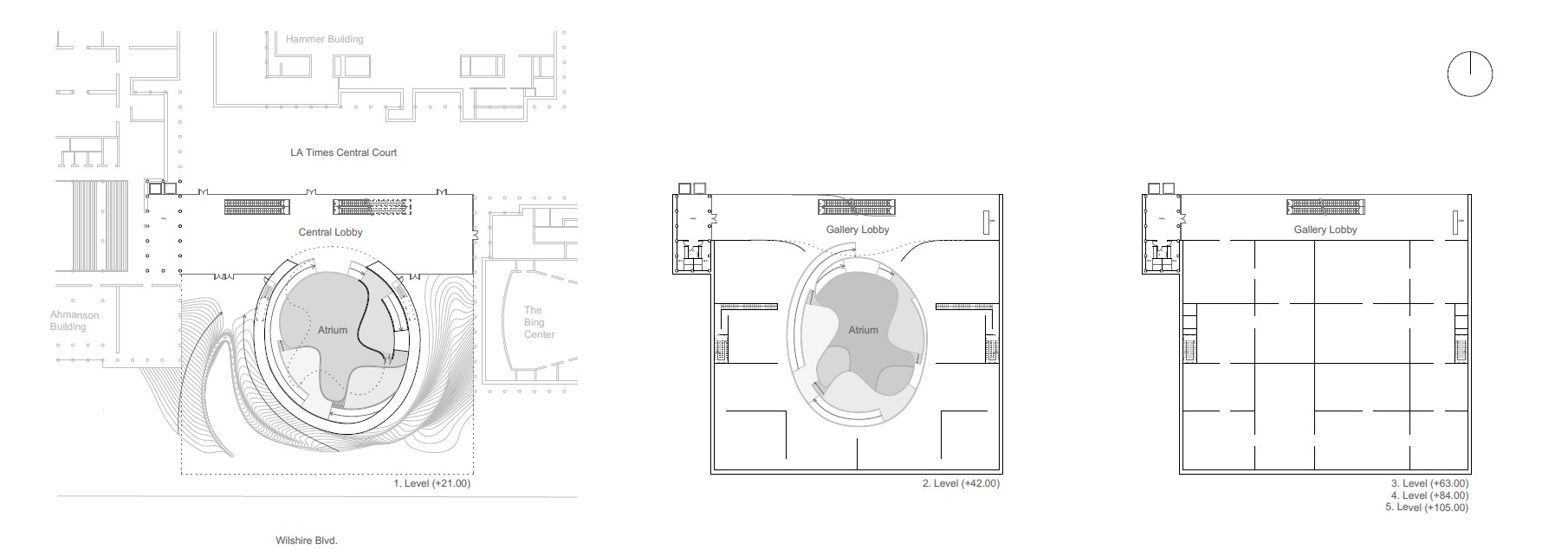
While retaining and adapting all of LACMA’s other existing buildings, we propose the removal of the Art of Americas Building which has served as a formidable barrier on Wiltshire Boulevard obstructing the city from LACMA’s galleries and public spaces. In its place, we introduce a new elevated stack of galleries which respects the proportions of the existing site. Creating an elevated new structure re-establishing the connection between Wilshire Boulevard and the LA Times Central Courtyard and gives this new entrance an accessible, sheltered forecourt. A gentle ramp /walkway welcomes visitors on Wilshire Boulevard to a spacious lobby level which is adjacent to LA Times Central Courtyard.
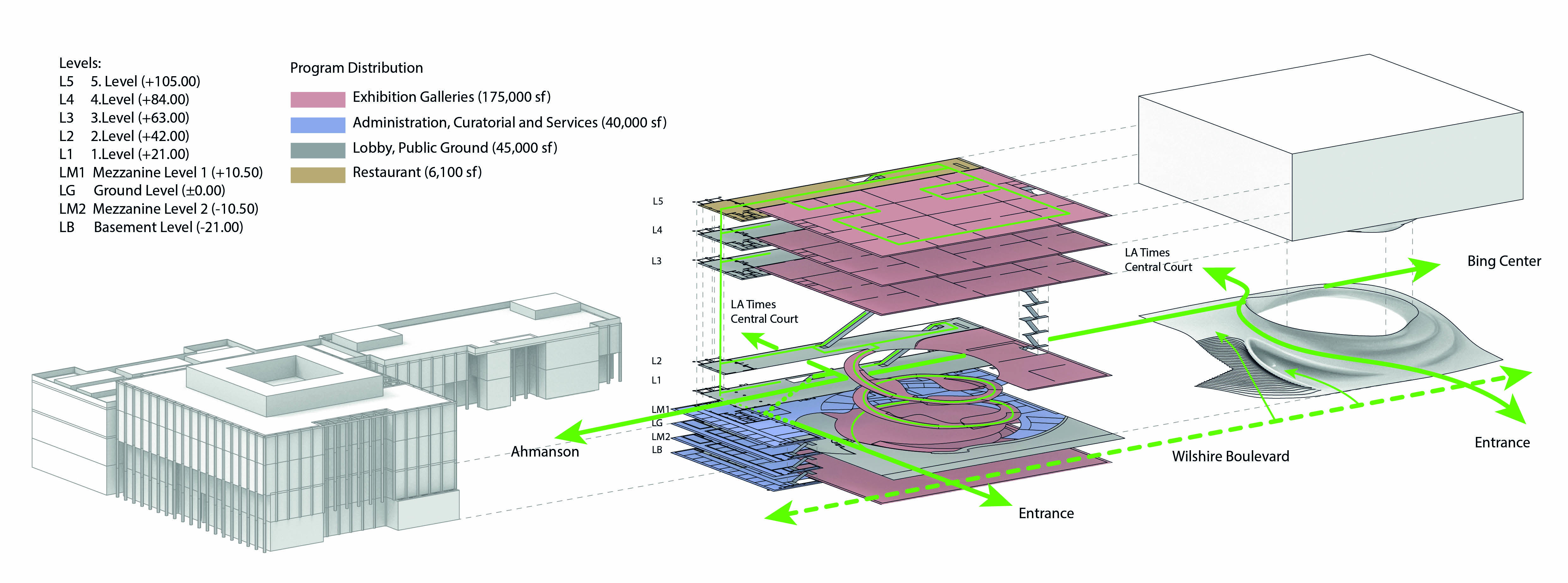
LACMA’s East Campus is formed by different components, the new central lobby area acts as a gathering point and introductive hub between the Ahmanson Building, the Hammer Building, the Bing Center and our newly proposed building. By introducing a direct entrance from the street, we are creating the easiest access to all levels and making the whole museum more accessible.
The fluidity of the design between Wiltshire Boulevard and elevated box which houses the galleries works as an intriguing architectural landscape establishing the pedestrian connection between LACMA’s public plaza and street level.
New Layout and Programmatic Distribution
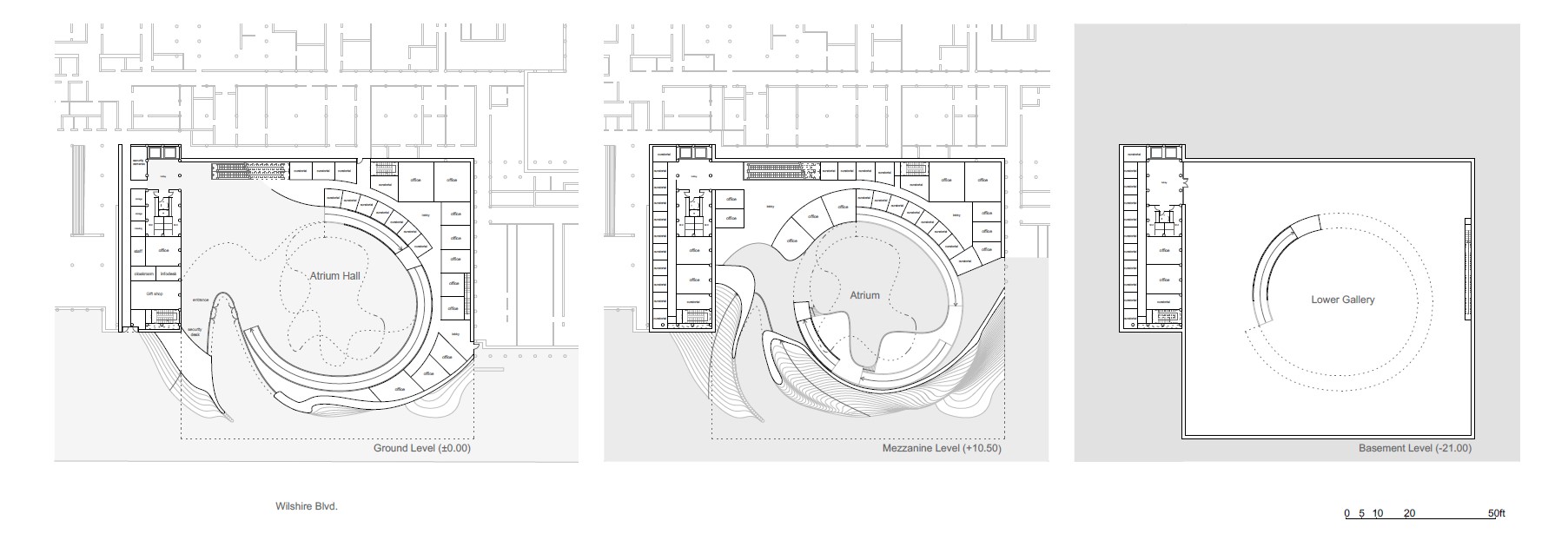
As the existing East Campus’ administrative, curatorial and service spaces are located at ground level, we are allocating newly built administrative and curatorial spaces adjacent to these existing facilities.
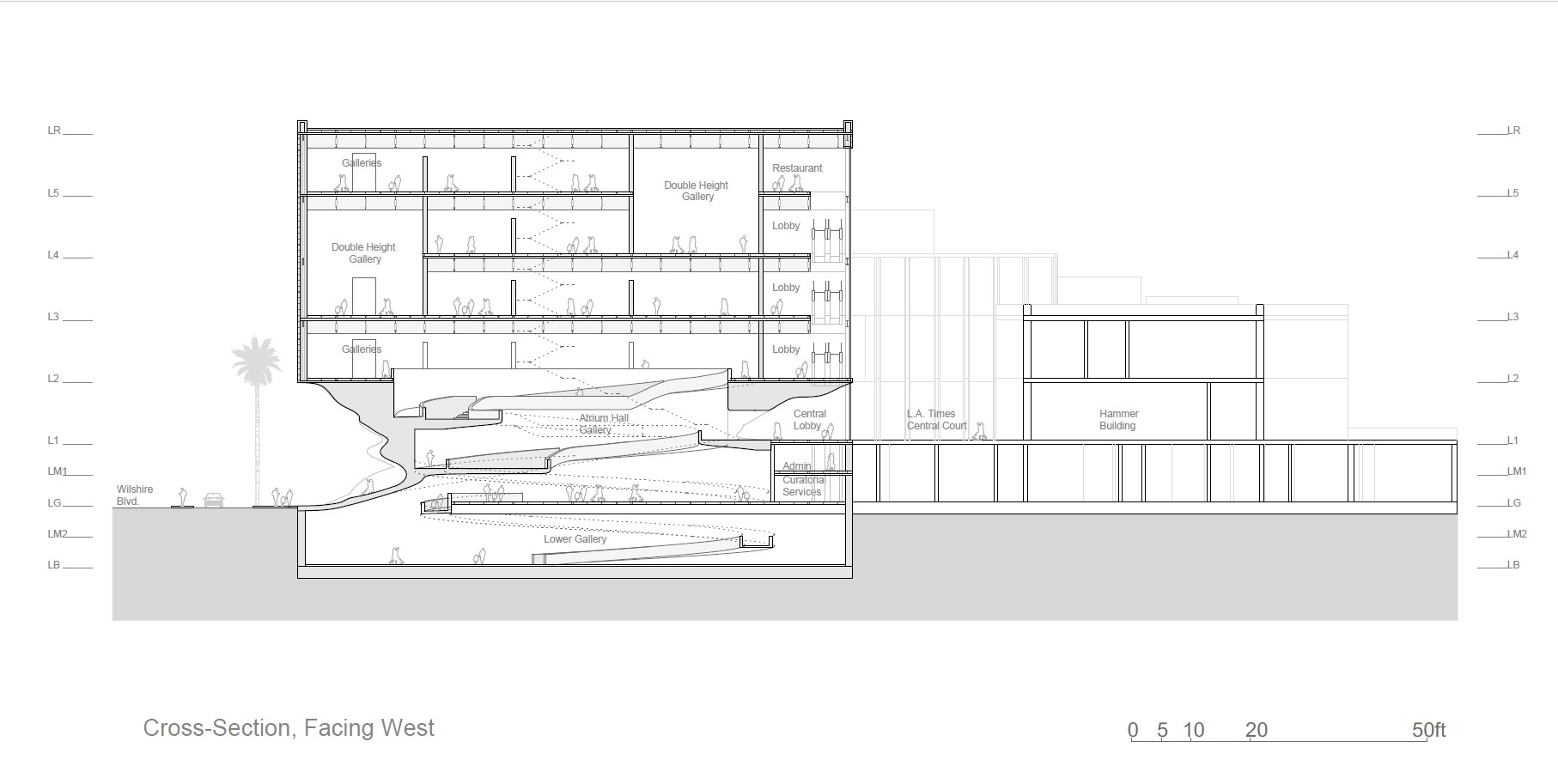
While we are offering generic white orthogonal art display galleries at higher levels, to enrich the museums wide variety of exhibition spaces, we shall introduce an alternative exhibition environment consisting of a spiralling promenade-like ramp, providing vistas onto gallery space within the atrium. This approach will give viewers open perspectives at different levels similar to the Guggenheim effect in New York.
Our proposal creates large central space for art lined with terraces of galleries looking into each other across and atrium, offering alternative points of view along the way to different levels. Works of art may be exhibited individually within these terraced gallery spaces, or the space may be conceived as a singular whole to exhibit one large work.
The central space (atrium hall) may also be used as a multipurpose venue offering an sense of place that becomes part of the museum’s identity; a collective core where people can appreciate art in a wider context of social exchange and public interaction.
Our proposed building’s south, east and west facing facades will not have openings, as they are dedicated to exhibition space, while the entirely-glazed north facade gives stunning views of the Hollywood Hills from the upper levels and serves as a lobby as well as a space for pause and refection next to the gallery spaces.
We propose to include a restaurant at the top level with panoramic views of the Hollywood Hills. Direct access to the restaurant will allow operating outside of museum hours. The restaurant may act as a stand-alone unit generating additional revenue source.
The square footage of the existing buildings (The Ahmanson Building, The Hammer Building, The Bing Center) without The Arts of Americas is approximately 255,000 sq.ft.
Our new proposed building being approximately 265,000 sq.ft in total, offering 225,000 sq.ft of gallery space, lobbies with recreational areas, and 40,000 sq.ft of administrative offices, curatorial areas and other services.
The project incorporates a total of 520,000 sq.ft which provides generous spaces for art and all supportive spaces that LACMA’s art and visitors deserve.
Saffet Kaya Bekiroglu
Saffet Kaya Architects
Ismail Cenk Gencer
Sevilay Goker
Ezaldeen AlSubainy